
Labral Repair/Shoulder Instability Surgery
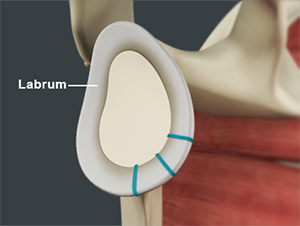
Labral repair, commonly performed to treat shoulder instability, mostly when a shoulder dislocates, but instability is sometimes less obvious. It is a minimally invasive surgical procedure designed to restore stability to the shoulder joint after a labral tear. Shoulder instability often occurs after a dislocation or repetitive overhead activity, leading to pain, weakness and a sensation that the shoulder may “slip out” of place. Labral repair aims to reattach and secure the torn tissue, helping patients safely return to work, sports, and daily activities.
What Is Labral Repair?
Labral repair is a surgical procedure that reattaches the torn labrum to the rim of the glenoid (socket). The labrum is a ring of cartilage that deepens the socket and stabilizes the shoulder joint. Most labral repairs are performed arthroscopically using small incisions, a camera and specialized instruments. Anchors and sutures are placed to secure the labrum back to the bone, restoring joint stability.
Anatomy
The shoulder is a ball-and-socket joint composed of:
- The humeral head (ball)
- The glenoid (socket) of the shoulder blade
- The labrum, a fibrocartilaginous rim that deepens the socket
- The rotator cuff muscles and tendons
- Ligaments that provide additional stability
Because the shoulder has a wide range of motion, it relies heavily on the labrum and surrounding soft tissues to maintain stability.
Pathology
Labral tears most commonly result from traumatic shoulder dislocations, repetitive overhead motion, or sudden forceful pulling injuries. A Bankart lesion occurs when the labrum tears from the front of the socket, often causing recurrent shoulder dislocations. SLAP (superior labrum anterior to posterior) tears affect the top portion of the labrum, this is often a chronic and nonsurgical issue in patient’s as they age, but it can negatively affect young people and when the labrum is torn, the shoulder may feel unstable, painful or prone to catching.
When Is Labral Repair Recommended?
Surgery may be recommended when conservative treatment fails and the patient has:
- Recurrent shoulder dislocations or subluxations
- Persistent instability despite physical therapy
- A confirmed labral tear on MRI
- Shoulder pain affecting sports or daily activities
- Traumatic instability in young or active individuals, even after 1st instability episode
A thorough physical examination and imaging studies help confirm the diagnosis.
What Does Preparation for Labral Repair Involve?
Preparation begins with a detailed orthopedic evaluation and imaging, typically MRI. Risk stratification may be required depending on overall health. Patients are advised to stop certain medications before surgery and arrange transportation home, as the procedure is usually outpatient. Preoperative education includes instructions on sling use and rehabilitation expectations.
How Is Labral Repair Performed?
The procedure is typically performed under general anesthesia with regional nerve block for pain control. Small incisions are made around the shoulder, and an arthroscope is inserted to visualize the joint. The surgeon cleans the torn area and places small anchors into the glenoid. Sutures attached to the anchors are used to secure the labrum back to the bone. The incisions are then closed.
What to Expect During Recovery After Labral Repair?
After surgery, the arm is placed in a sling for several weeks to protect the repair. Physical therapy begins with gentle passive motion and progresses gradually to strengthening exercises. Most patients return to daily activities within a few months, while returning to sports may take six to nine months. With proper rehabilitation, stability and function are typically restored.
Quick Links
- Shoulder Anatomy
- Arthritis of the Shoulder
- Rotator Cuff Tear
- Shoulder Dislocation
- Frozen Shoulder
- Shoulder Instability
- Shoulder Fracture
- Biceps Tendon Rupture
- Shoulder Arthroscopy
- Total Shoulder Replacement
- Reverse Shoulder Replacement
- Shoulder Hemiarthroplasty
- Rotator Cuff Repair
- Shoulder Stabilization